




Contents
Capability Maturity Model
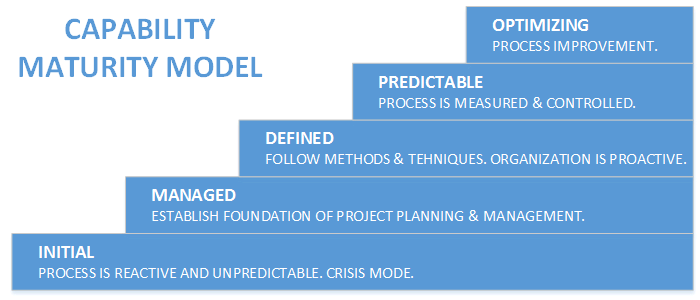
A way an organization is ranked in terms of the efficiency of their processes. There are five steps to this model:
- Initial – chaotic, ad hoc, individual heroics. The starting point for use of a new or undocumented repeat process.
- Repeatable – the process is at least documented sufficiently such that repeating the same steps may be attempted.
- Defined – the process is defined/confirmed as a standard business process, and decomposed to levels 0, 1 and 2 (the latter being Work Instructions).
- Managed – the process is quantitatively managed in accordance with agreed-upon metrics.
- Optimizing – process management includes deliberate process optimization/improvement.
More information here: http://en.wikipedia.org/wiki/Capability_Maturity_Model#Levels
* Run away from companies that don't know what CMM is.
Project Management Fundamentals
Core Competencies of Successful Project Managers
- Attention to Detail
- Organized (if you can't be organized, you can't organize others)
- Documentation
- Time Management
- Interpersonal Skills (you catch more flies with honey than with vinegar)
- Conflict Management (in a personable way – conflict is inevitable)
- Leadership (take lead and drive delivery – that's what you're there for.
- Critical and Analytical Thinking
- Independent Thinking. Need to think on your feet.
4 Key Components to Successfully Managing Projects
- Scope
- Time
- Risk
- Cost (if you have to give up one, give up this one)
Pitfalls for PM's
- Wrong choice of company [to work for].
- Failure to have conversations with manager if project is spiraling.
- Don't work well with their manager.
- Google This: Completed Professional Work
- Provides different leadership styles. Include decision making style, leadership style, etc.
- Works on projects over their head. Instead, choose projects a few sizes too big, but still small enough to accomplish.
- Don't fail – this will tarnish your reputation permanently.
- Diving-in without understanding scope of meeting.
- Poorly managing change requests / change management. Never accept changes without reviewing impact on plan first.
- Being bullied or intimidated by others. Don't be bullied or intimidated by others.
Managing Multiple Projects
Multiple projects fall into one of two categories:
- Completely independent projects; or
- Programs, which may look like two or more projects, but are related to each other by scope, cost, time, or resources.
- For Projects, always try to keep projects separate unless they're truly a program.
- For Programs:
- Need a tool like HP Project and Portfolio Management (PPM) to manage the program.
- Much more experience needed for managing programs.
- Usually need 10-16 years to get into this field.
- Common job titles are "Implementation Directors," Program Managers," etc.
- Multiple projects can be tied to programs in Microsoft Project an external resource link.
Communication Strategies
- Hold regular focus meetings:
- For large projects, meet 1x per week.
- For smaller projects, meet 1x every two weeks.
- Progress meetings should cover:
- What's been completed.
- What's not been completed.
- What's planned for the next reporting period.
- The top 3 risks and issues.
- Review the issue log in your meetings.
- Always have a project sponsor (a business person) and insist on meeting this person weekly.
- Kick-Off Meeting: meet and discuss the scope of the project and make sure everybody is on board with it.
Management by Exception
- Example: produce a common organization level plan. Everybody says "I agree to comply in all except A, B, C."
- Focus on the top 5 exceptions at the project management level.
- Put external dependencies (especially from other projects) in different colors. This will keep you focused on the items that are out of your control, but necessary for you to successfully deliver by your deadline date.
Past Implementation Support
Allot for a minimum of 2-weeks
Maximum allotment should be up to 1-month, but not longer
Keep to a minimum, but also keep time frame appropriate
Continuous Improvement Log
- One should be kept on the business side, and another on the IT side.
- This is a way for organizations to move up the Capability Maturity Model.
Terminology
Infrastructure
- Bottom of the barrel position.
- PM's are often pigeon holed here.
- Stay away from this type of work; it's a dead end job.
Applications
This is the next level up from infrastructure.
Small Application Projects:
- Seek an SME (Subject Matter Expert).
- Either require minimal interface setup or no interface setup at all.
- Examples of minimal interface setup include installing a server, but not performing load balanced, etc.
Medium / Large Projects:
- Require additional customization.
- Examples may include installing a server and performing load balancing, etc.
6 Sigma
Focus on Quality
Lean
Focus on Efficiency
Agile Project Management
The principles of waterfall project management are transferable to agile project management. The primary difference between the two are shorter time periods for agile project management.
Agile Development
Always get a blueprint for agile projects, or else projects will be a disaster.
Regression Testing
Special testing is necessary for agile projects. Due to the nature of agile application development, multiple modules of code may be developed during sprints. Standard testing practices will help to validate that each module works correctly. In addition to standard testing practices, regression testing is also necessary. Regression testing confirms that all modules will work together harmoniously when integrated together (usually at launch).
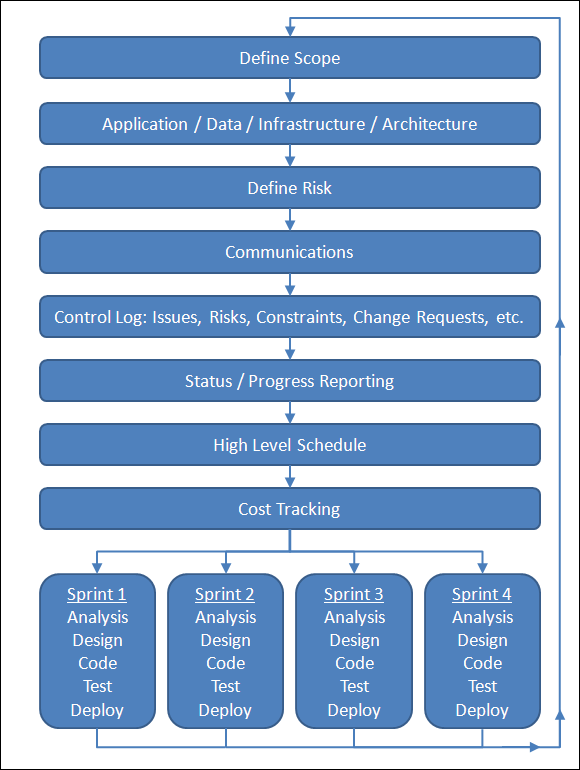
Agile Project Management Cycle
Multiple sprints can occur concurrently in agile development. This is similar to managing multiple waterfall projects concurrently.
Project Management as a Profession
Many companies don't see value in PM as a profession. There are three different types of companies out there:
- Companies that don't value PM and never will.
- Mature organizations that value PM.
- Companies growing at a super high rate and need PM. Look for these types of growth companies.
Project Management Hierarchy
- Junior PM: 1-3 years experience
- PM: 4-8 years experience
- Senior PM: 10-15+ years experience
- Program Manager: 15+ years experience
- Strategic & Business Planning: a good long-term career move
Pay (Phoenix Salaries)
- Salary
- $55-65k for 4-years experience. A typical salary for companies that do not value PM's.
- $70-85k for 4-years experience. A typical salary for companies that do value PM's.
- $90k+ for Senior PM's
- $120k+ for Program PM's
- Bonuses
- It's very common to receive performance bonuses.
- Discretionary or "spot" bonuses are also also common.
- Senior and Program PM's also earn management bonuses (i.e. share options, etc).
- Other Constituents
- Build into employment contract that the company will pay for PDU's for continuing education and will allow time away from work to complete.
Good Segments to Focus On
- Growth companies
- Healthcare
- Technology (may need engineering degree to work for ultra technical companies such as Intel, Honeywell, etc.)
- Process Engineering / Process Improvement projects are good to get into.
Segments to Avoid: Government
- Good for stability, no opportunity for growth.
- If you're a go-getter, stay away from government.
- Contractor for government is actually more lucrative than working for government.
Who do PM's Report To?
- Usually report to the project sponsor or the program manager.
- Very common to not have direct reports.
Typical Workweek Hours
- Working more than 45+ hours is a red flag. Indicates that PM is either incompetent or over worked.
- The number of projects you're working on at any time vary depending on the size of the project:
- 1-large project
- 2-Medium projects
- 3-4 Small projects
- Never load schedules more than 80% of your total working time.
Multi-Tasking
- Some multi-tasking may occur in PM, but more on the side of business analysis and process engineering
- Tasks such as administration, training, etc are not common for PM's.
Is Full-Time Employment Common?
- The PM industry has a mixture of both.
- PM contractors almost always work though an agency to find work.
How to Sell Myself
- "I have a degree and a PMP Certification. I want to take my career to the next level and am looking for opportunity to grow. I'd like to refine my craft."
- Focus on small/small-medium projects:
- 5-15 people
- Budget of $100,000 – $500,000
- 3-8 month time frames
- Ask for mentorship.
Finding Work
- Look into Tek Systems. They are a contractor for contract PM's.
- Look for contract-to-hire positions.
- 30, 60, 90, and 180 days to hire are most common
- Hourly rate for contract period should be higher than the salary they're trying to convert you to.
- Look for companies that you work for and they hire you out to other companies as a consultant (KPNG is one of these companies).
- Come with your own tool kits (templates).
My Original Questions
Met with Elaine on 02/29/2012:
- Value of obtaining certification (PMP, etc).
- What is the role of agile project management in today’s landscape?
- Tips for transitioning a management culture from "just do it now" to "let's build and execute a plan."
- How common is it to lead a project without staff reporting directly to you?
- Are most project management jobs by contract (1099)? Or is full-time employment common place?
- Recommendations for software and documentation.
- Strategies for managing multiple projects.
- What types of industries should I be focusing on?
- What is the typical pay range from PM's?
- How many hours in a typical work week?
- What are some of the best practices for becoming an effective PM?
- What are common pitfalls for PM's?
- Do most PM's strictly focus on project management? Or is there often an expectation to perform other tasks?
Helpful URL's
| Category | Description | URL |
|---|---|---|
| Reference | Capability Maturity Model | http://en.wikipedia.org/wiki/Capability_Maturity_Model |
| Software | HP Project and Portfolio Management | http://www8.hp.com/us/en/software/software-solution.html?compURI=tcm:245-936961 |
