




Contents
Set Theory
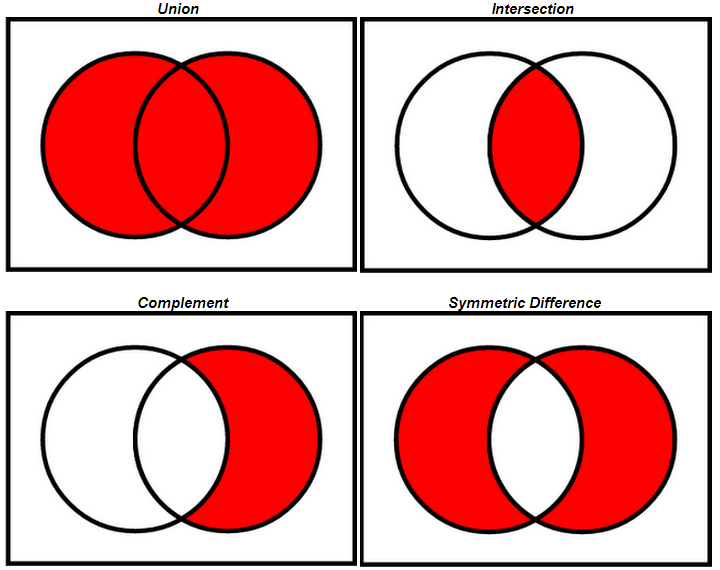
Set theory is the branch of mathematics that studies sets, which are collections of objects. Although any type of object can be collected into a set, set theory is applied most often to objects that are relevant to mathematics.
Entity Relationship Model
An entity-relationship model is a systematic way of describing and defining a business process. The process is modeled as components (entities) that are linked with each other by relationships that express the dependencies and requirements between them, such as: one building may be divided into zero or more apartments, but one apartment can only be located in one building. Entities may have various properties (attributes) that characterize them. Diagrams created to represent these entities, attributes, and relationships graphically are called entity–relationship diagrams (ERD).
An ER model is typically implemented as a database. In the case of a relational database, which stores data in tables, every row of each table represents one instance of an entity. Some data fields in these tables point to indexes in other tables; such pointers represent the relationships. Software engineers use three levels of ER models:
Conceptual Data Model
This is the highest level ER model in that it contains the least granular detail but establishes the overall scope of what is to be included within the model set. The conceptual ER model normally defines master reference data entities that are commonly used by the organization. Developing an enterprise-wide conceptual ER model is useful to support documenting the data architecture for an organization.
A conceptual ER model may be used as the foundation for one or more logical data models (see below). The purpose of the conceptual ER model is then to establish structural metadata commonality for the master data entities between the set of logical ER models. The conceptual data model may be used to form commonality relationships between ER models as a basis for data model integration.
Logical Data Model
A logical ER model does not require a conceptual ER model, especially if the scope of the logical ER model includes only the development of a distinct information system. The logical ER model contains more detail than the conceptual ER model. In addition to master data entities, operational and transactional data entities are now defined. The details of each data entity are developed and the entity relationships between these data entities are established. The logical ER model is however developed independent of technology into which it is implemented.
Physical Data Model
One or more physical ER models may be developed from each logical ER model. The physical ER model is normally developed to be instantiated as a database. Therefore, each physical ER model must contain enough detail to produce a database and each physical ER model is technology dependent since each database management system is somewhat different.
The physical model is normally instantiated in the structural metadata of a database management system as relational database objects such as database tables, database indexes such as unique key indexes, and database constraints such as a foreign key constraint or a commonality constraint. The ER model is also normally used to design modifications to the relational database objects and to maintain the structural metadata of the database.
ER Diagram Symbols
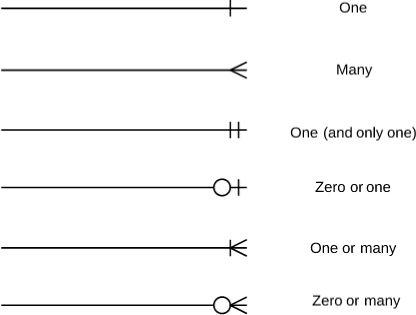
Relationships illustrate an association between two tables. In the physical data model, relationships are represented by stylized lines. Cardinality and ordinality, respectively, refer to the maximum number of times an instance in one entity can be associated with instances in the related entity, and the minimum number of times an instance in one entity can be associated with an instance in the related entity. Cardinality and ordinality are represented by the styling of a line and its endpoint, as denoted by the chosen notation style. Also called crow's foot database notation.
Terminology
Primary Key
A primary key is a column or combination of columns whose values uniquely identify a row or record in the table. The primary key(s) have a unique value for each record or row in the table.
Foreign Key
A database key that is used as a reference to relate one entity to another entity. It may be a unique value, or used in conjunction with another Foreign Key to create a unique value.
Schema
A blueprint of how a database is organized and constructed. Schemas typically show tables, relationships, etc.
Normalization
The process of organizing the fields and tables of a relational database to minimize redundancy and dependency. Normalization usually involves dividing large tables into smaller (and less redundant) tables and defining relationships between them. The objective is to isolate data so that additions, deletions, and modifications of a field can be made in just one table and then propagated through the rest of the database using the defined relationships.
Helpful URL's
| Category | Description | URL |
|---|---|---|
| Wikipedia | Set Theory | http://en.wikipedia.org/wiki/Set_theory |
| Wikipedia | Union | http://en.wikipedia.org/wiki/Union_(set_theory) |
| Wikipedia | Intersection | http://en.wikipedia.org/wiki/Intersection_(set_theory) |
| Wikipedia | Complement | http://en.wikipedia.org/wiki/Complement_(set_theory) |
| Wikipedia | Symmetric Difference | http://en.wikipedia.org/wiki/Symmetric_difference |
