




Contents
Good is the Enemy of Great
This is one of the key reasons why we have so little that becomes great. We don't have great things principally because we have good things.
Level 5 Leadership
Level 1: Highly Capable Individual
Makes productive contributions through talent, knowledge, skills, and good work habits.
Level 2: Contributing Team Member
Contributes individual capabilities to the achievement of group objectives and works effectively with others in a group setting.
Level 3: Competent Manager
Organizes people and resources toward the effective and efficient pursuit of predetermined objectives.
Level 4: Effective Leader
Catalyzes commitment to and vigorous pursuit of a clear and compelling vision, stimulating higher performance standards.
Level 5: Level 5 Executive
Builds enduring greatness through a paradoxical blend of personal humility and professional will.
First Who… Then What
Paradigm
- To take a company from good to great, first set a new direction, vision, or strategy
- Next, get people committed and aligned behind that new direction.
Reality
- Get the right people on the bus, the wrong people off, the right people in the right seats, and then figure out where to drive it.
- Must begin with "who" rather than "what."
- If people are on the bus because of 'where,' then what happens when the bus changes direction?
- The right people on the bus eliminate the need to motivate and manage.
- It is who you pay, not how you pay them.
- Be Rigorous, Not Ruthless. To be rigorous means to apply exacting standards at all levels. To be rigorous:
- When in doubt don’t hire, keep looking.
- When you know you need to make a people change, act.
- Put your best people on your biggest opportunities, not your biggest problems.
Confront the Brutal Facts
- Confront the brutal facts, yet never lose faith.
- Facts are better than dreams.
- When it came to making tough decisions the good-to-great companies infused the entire process with the brutal facts of reality. When your honest about your situation the solutions are generally self evident.
- Create a culture where people have an opportunity to be heard. The best way to demotivate people is to hold out false hope.
- Expending energy trying to motivate people is a waste of time. This is why brutal facts are better than motivating.
4 Basic Principles in Creating the Culture:
- Lead with questions not answers
- Engage in dialog and debate, not coercion
- Conduct autopsies, without blame
- Build red flag mechanisms. Turn information into information that can’t be ignored.
The Stockdale Paradox
- Named after Jim Stockdale, prisoner of war 1965 – 1973, who was tortured over 20 times.
- Retain faith that you will prevail in the end, regardless of the difficulties. And at the same time, confront the most brutal facts of your current reality, whatever they might be.
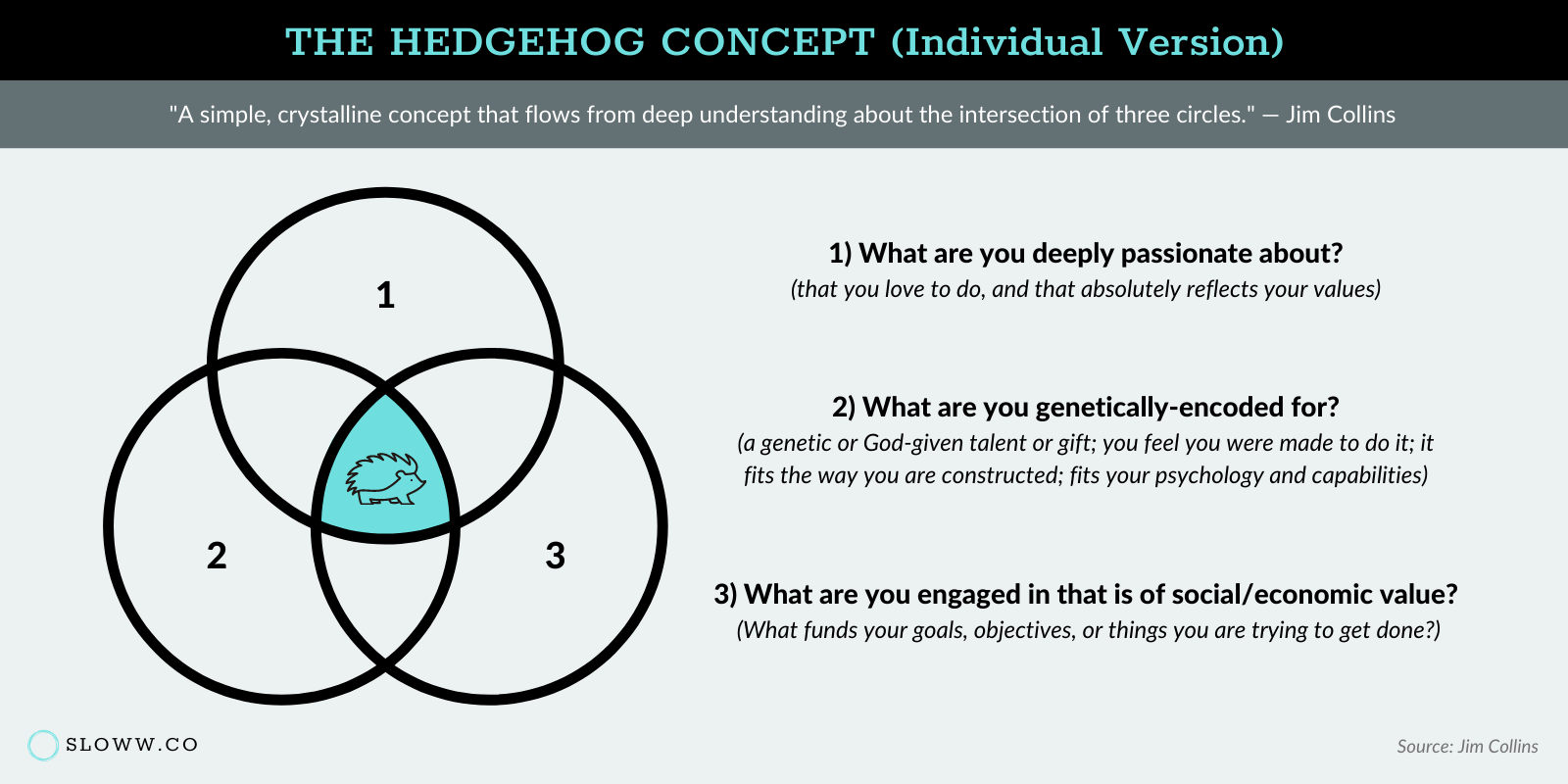
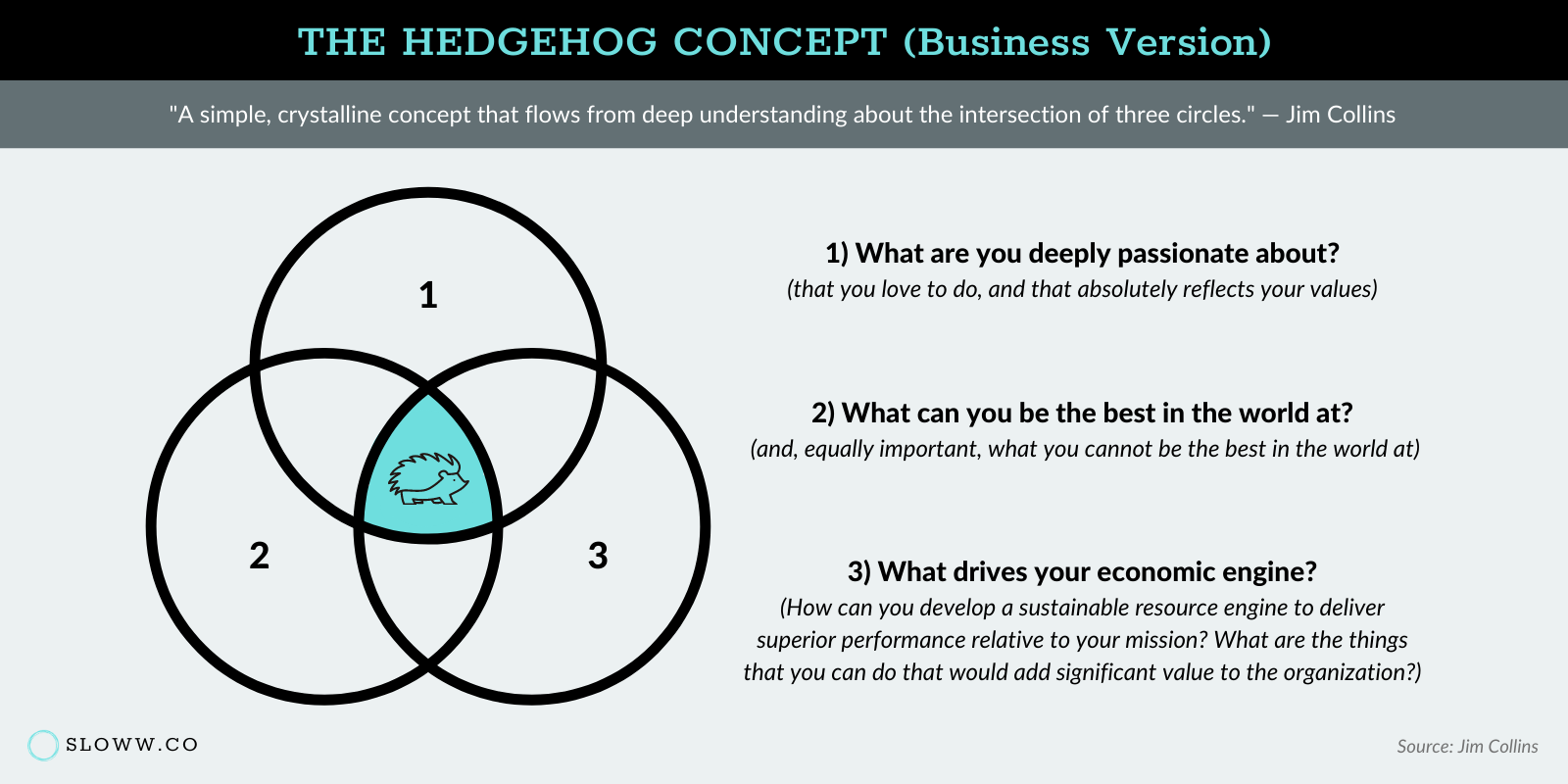
The Hedgehog Concept
A Culture of Discipline
Discipline Action within the Three Circles
- Build a culture around the idea of freedom and responsibility, within a framework. Hire self-disciplined people who don't need to be managed, and then manage the system, not the people.
- Fill that culture with self-disciplined people who are willing to go to extreme lengths to fulfill their responsibility.
- Don't confuse a culture of discipline with a tyrannical disciplinarian.
- Adhere with great consistency to the Hedgehog Concept, exercising an almost religious focus on the intersection of the three circles.
- Start a 'Stop Doing' List – it is more important than a 'To Do' List
Technology Accelerators
Technology and the Hedgehog Concept
- Good-to-great companies adapt technology to fit their Hedgehog Concept.
Technology as an Accelerator, Not a Creator, of Momentum
- Good-to-great companies never began their transition with pioneering technology, for the simple reason that you cannot make good use of technology until you know which technologies are relevant.
- Technology alone cannot create sustained great results.
Technology Trap
- Mediocrity results first and foremost form management failure, not technology failure.
- Technology is never the primary cause of either greatness or decline.
Technology and the Fear of Being Left Behind
- Great companies respond with thoughtfulness and creativity, driven by a compulsion to turn unrealized potential into results.
- Mediocre companies react and lurch about, motivated by fear of being left behind.
The Flywheel and the Doom Loop
Flywheel Concept
- Imagine that your task is to rotate a massive 30 foot, 5,000 pound disk.
- Difficult to move, but momentum keeps building until breakthrough.
- "What was the one big push that made it go so fast?" There was no single push that accomplished this.
Buildup and Breakthrough
- Good-to-great companies came about by a cumulative process – step by step, similar to spinning the flywheel above.
- There was no single defining action, no one killer innovation, and no solitary lucky break.
The Flywheel Effect
Think of a circular model that continues to wrap around highlighted by four themes:
- Accumulation of visible results.
- People line up, energized by results.
- Flywheel builds momentum.
- Steps forward, consistent with Hedgehog Concept.
The Doom Loop
- Rather than accumulating momentum, turn by turn of the flywheel, the comparison companies tried to skip buildup and jump immediately to breakthrough.
- Then, with disappointing results, they’d lurch back and forth, failing to maintain a consistent direction.
Doom Loop Model
- No buildup; no accumulated momentum.
- Disappointing results.
- Reaction, without understanding.
- New direction, program leader, event, fad, or acquisition.
From Good to Great to Built to Last
Chapter 9 is a comparison of Good to Great and a previous book by Collins, Built to Last.
Four Conclusions When Looking at Both Studies
- The enduring great companies from Built to Last followed the good-to-great framework.
- Good to Great is not a sequel to Built to Last but a prequel.
- To make the shift form a company with sustained great results to an enduring great company of iconic stature, apply the central concept from Built to Last: Discover your core values and purpose beyond making money and combine this with the dynamic of preserve the core/stimulate progress.
- Good to Great answers a fundamental question raised, but not answered, in Built to Last: What is the difference between a "good" BHAG (Big Hairy Audacious Goal) and a "bad" BHAG.
- Clock Building, Not Time Telling. Build an organization that can endure and adapt through multiple generations of leaders and multiple life cycles.
- Genius of AND. Instead of choosing A or B, figure out how to have A and B – purpose AND profit, continuity AND change, freedom AND responsibility
- Core Ideology. Instill core values and core purpose as principles to guide decisions and inspire people.
- Preserve the Core; Stimulate the Progress. Preserve the core ideology as an anchor point while stimulating change, innovation, and renewal in everything else.
Why Greatness?
- The real question is not, "Why Greatness?" but "What work makes you feel compelled to try to create greatness?"
- If you have to ask the question, "Why should we try to make it great? Isn't success enough?" then you’re probably engaged in the wrong line of work.
Additional Concepts
Types of Risks
- Death Line Risk: Risks that could severely damage the organization.
- Asymmetric Risk: Risks with greater potential downside than upside.
- Uncontrollable Risk: Risks that expose the organization to things they have little ability to manage or control.
Helpful URL's
| Category | Description | URL |
|---|---|---|
| Author | Jim Collins | http://www.jimcollins.com/ |
| Audiobook | Good To Great | http://mp3.jerryrcole.com/_Music/Audio%20Books/Jim%20Collins%20-%20Good%20To%20G... |
| Audiobook | Great By Choice | http://mp3.jerryrcole.com/_Music/Audio%20Books/Jim%20Collins%20-%20Great%20By%20... |
